
What is transnasal esophagoscopy?
Transnasal esophagoscopy is a less invasive and more comfortable way to examine the esophagus. It is an alternative to conventional esophagoscopy.

The esophagus is the food passage between the throat and stomach
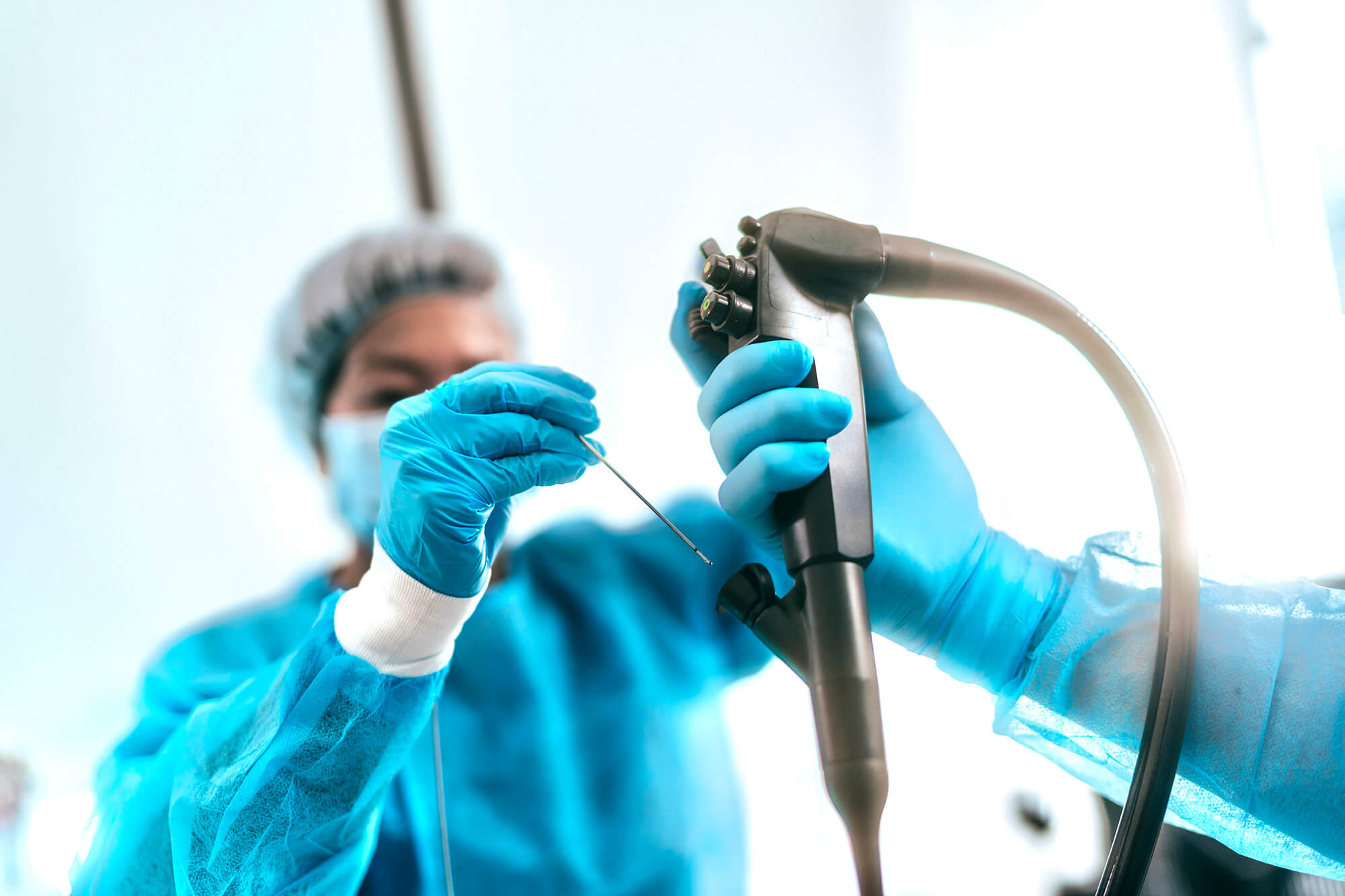
The examination involves inserting a thin flexible endoscope through the nose, down into the esophagus. This allows direct examination of the esophagus and stomach without the need for sedation.
We can compare transnasal esophagoscopy to two other ways of examining the esophagus:
(1) Conventional flexible endoscopy. This method involves passing a wider flexible endoscope through the mouth into the esophagus. This examination requires sedation.
(2) Rigid esophagoscopy. This method involves passing a rigid metal tube through the mouth into the esophagus. It requires general anesthesia.
Advantages of transnasal esophagoscopy
The primary advantage of transnasal esophagoscopy is that patients do not require sedation or general anesthetic. Hence the procedure is less invasive, safer, and procedure time and hospital stay are shorter.
Passing the endoscope through the nose rather than the throat can also mean less gagging for the patient.
For these reasons transnasal esophagoscopy can be particularly suitable for patients apprehensive about undergoing more invasive procedures.
Why do I need transnasal esophagoscopy?
Unexplained throat symptoms
One of the main reasons for performing transnasal esophagoscopy is unexplained throat symptoms. A throat symptom may be the only sign of a problem in the esophagus, and may require examination of the esophagus. Examples of such symptoms include persistent unexplained throat discomfort, feeling a lump in the throat, or the sensation of food sticking in the throat or chest during swallowing.

Yeast infection in the esophagus (left) with normal throat examination (right)
Evaluation of gastroesophageal reflux
Gastroesophageal reflux or GERD happens when digestive juices from the stomach back-flow into the oesophagus. Sometimes the back-flow reaches the larynx and pharynx, resulting in symptoms like hoarseness, throat clearing, and chronic cough. Furthermore, GERD can injure the lining of the esophagus, causing pain and swallowing difficulty. In addition, GERD can lead to pre-cancer or cancer, sometimes with few symptoms. transnasal esophagoscopy allows us to assess the esophagus and can guide appropriate management. The examination can also identify conditions such as hiatus hernia, in which the lower esophageal valve is faulty, making it easier for acid reflux to occur.
Assessing the esophagus in swallowing disorders.
Transnasal esophagoscopy can identify abnormalities in the esophagus that may impair swallowing function. Examples of such lesions include eosinophilic esophagitis, Barrett’s esophagus, pouches, tumours, and disorders of muscle motility.
Diagnosis of head and neck cancer.
Transnasal esophagoscopy allows us to see the upper aerodigestive tract clearly from throat to stomach. Furthermore, suspicious areas can be biopsied if needed without requiring general anesthesia. In addition, transnasal esophagoscopy provides a non-invasive means to screen the esophagus for esophageal cancer or precancerous change, which can occur in up to 15% of patients with head and neck cancer. Screening leads to early detection and intervention hence improving patient outcomes.
Foreign body in the throat or eosphagus.
Transnasal esophagoscopy is also useful to examine the esophagus in patients with a suspected foreign body stuck there. It may be possible to remove a fine foreign body using transnasal esophagoscopy. However larger foreign bodies may require a procedure under general anesthetic.

Ulcer in the lower esophagus from previously impacted foreign body
Guiding speaking valve insertion after laryngeal cancer surgery.
Insertion of a speaking valve between the windpipe and esophagus can enable speech in patients who have undergone surgery to remove the voice box, usually for cancer. This procedure is called a tracheoesophageal puncture. Transnasal esophagoscopy allows precise placement of the speaking valve in the esophagus, without any need for sedation.
Guiding balloon dilatation of the upper esophagus.
If the upper esophageal valve is too tight, swallowing can be difficult. This can result from previous radiotherapy or surgery, or to spasm due to neurological causes. Dilating the valve with a special balloon can help swallowing to improve.
What to expect during transnasal esophagoscopy
Pre-procedure preparation
You need to refrain from food and drink for at 6 hours before the procedure. This is important so that the stomach is empty at the time of the examination
Anesthesia
You will not need sedation for the procedure. However local anesthetic spray helps to minimize discomfort in the nose and throat.
Endoscope insertion
The endoscope is carefully and gently advanced through your nose. An image on a monitor from the endoscope guides the steering.
When the tip of the endoscope reaches the back of your throat you will need to swallow. This allows the endoscope to pass smoothly into the esophagus.
Diagnostic evaluation
The esophagus is carefully examined from top to bottom. When the lower esophagus is reached you will be asked to sniff in and hold your breath. This maneuver tightens the diaphragm which forms part of the lower esophageal valve.
TNE also examines the stomach. Part of this involves turning the endoscope so that it looks back at itself. This maneuver lets us examine the lower esophageal valve from below.
We usually take a few biopsies from the stomach to test for an infection known as Helicobacter Pylori. The biopsies are painless. However you will see the nurse passing a thin cable down through the the endoscope. This cable has a mini biopsy forcep at the end of it. Further biopsies are sometimes needed if there are abnormal findings.
The whole procedure will be over within minutes.
After the procedure
Following transnasal esophagoscopy, patients typically experience minimal discomfort and can resume normal activities shortly thereafter.
After the examination the throat will feel numb due to the anesthetic. This sensation may last up to an hour or so, and it is important to avoid very hot food or drink during this period to avoid accidentally burning your throat, and also to eat and drink slowly to avoid choking.
Is it uncomfortable and what are the risks?
Transnasal esophagoscopy is a safe procedure, and usually well tolerated.
You can expect discomfort in the nose and throat during the procedure due to pressure from the endoscope. However the anesthetic spray helps minimise this.
You will also feel bloated. This is due to air used to inflate the esophagus and stomach to get a clear view. The bloating sensation is usually mild and tolerable.
Serious complications during transnasal esophagoscopy are very rare. The most common complications are minor nose bleeds and fainting, which occur about 1 to 4% of the time and usually recover quickly without specific treatment.
If you are taking blood thinners please let the doctor know. You will need to stop blood thinners before the procedure, particularly if biopsies may be needed. Please tell us what medication you are taking when planning for transnasal esophagoscopy.
Compared to conventional trans-oral flexible upper gastrointestinal endoscopy, transnasal esophagoscopy is safer as it avoids the need for intravenous sedation, which accounts for most complications with conventional endoscopy. Patients who have experienced both procedures often prefer transnasal esophagoscopy.
Are there alternatives to transnasal esophagoscopy?
Depending on the reason for performing transnasal esophagoscopy, there may be alternative examinations available.
For example, x-ray studies can be used to examine the esophagus. However endoscopy is still the best way to see inside the esophagus and allows us to take biopsies where necessary.
Conventional flexible endoscopy is an alternative, and necessary if we need to examine the small intestine. The transnasal esophagoscope only goes as far as the stomach.
Rigid esophagoscopy is the preferred examination if we need to remove a large foreign body in the esophagus.
If we need information on how well the muscle wall of the esophagus contracts, then x-ray studies or pressure studies in the esophagus may be better. Nonetheless, transnasal esophagsocopy can also give information about muscle function as the patient is fully awake and able to swallow.
Transnasal esophagoscopy at AdvancedENT
Dr Lau pioneered the use of trans-nasal esophagoscopy in ENT practice in Singapore about 15 years ago. Furthermore, after seeing the benefits to patients he has been using transnasal esophagoscopy regularly in his ENT practice ever since.
Dr Lau is a key opinion leader regionally in the use TNE and regularly teaches and lectures on the technique and its applications.
A few years ago, Dr Lau developed a technique using TNE for the creation of tracheo-esophageal puncture using a mini-tracheostomy set which is highly accurate and causes minimal trauma. He also designed a device to enable single-stage insertion which underwent successful first in human trials at the Singapore General Hospital.
Contact us if you are concerned about symptoms and would like to find out more about transnasal esophagoscopy. Dr Lau will carefully assess your symptoms and condition to determine if transnasal esophagoscopy is the right procedure form you.