
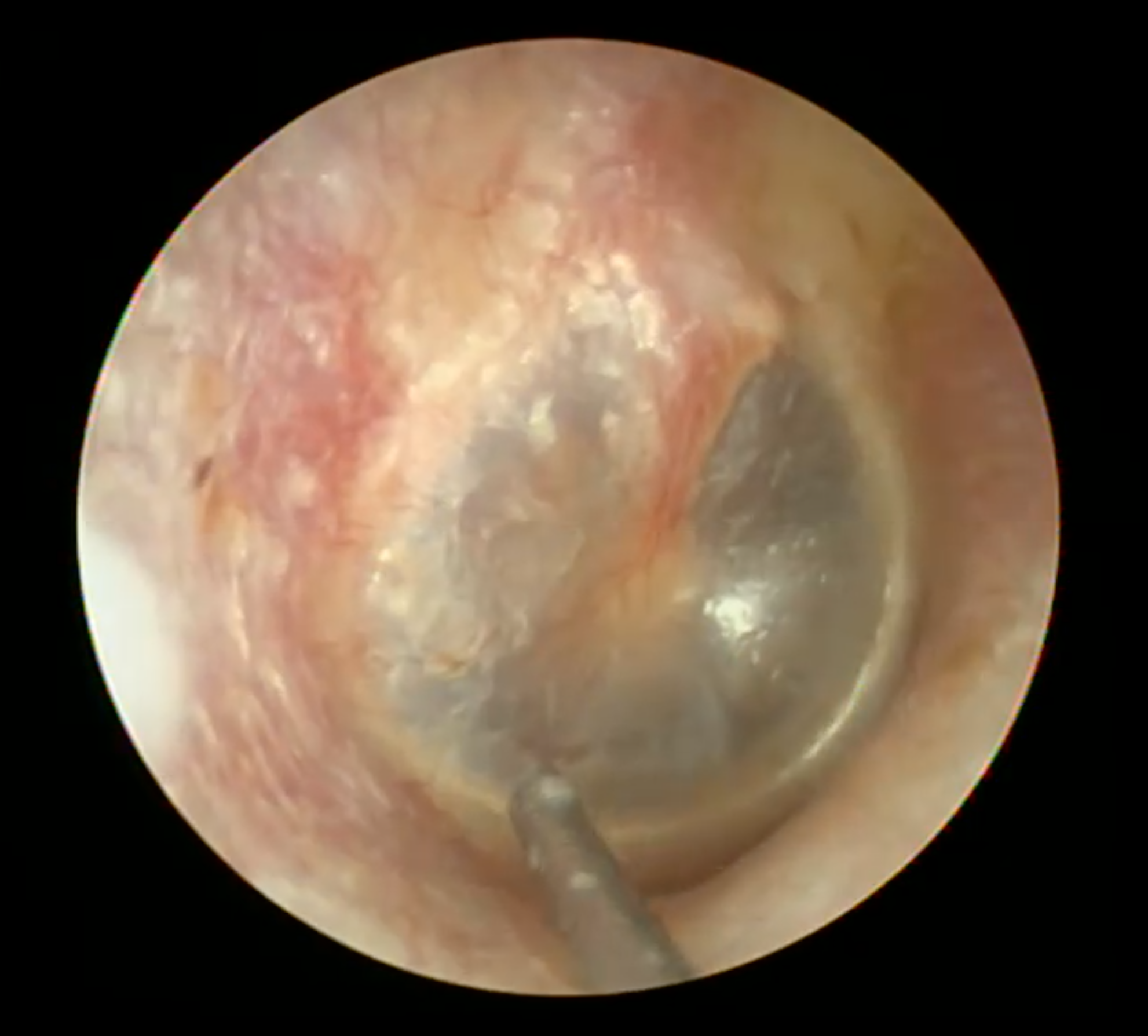
What is intratympanic steroid injection?
Intratympanic steroid injection or ITSI refers to injection of steroid through the ear drum into the middle ear. It is a type of treatment for sudden sensorineural hearing loss. The injection allows high concentrations of steroid to diffuse into the inner ear without going through the blood stream. The steroid reduces inflammation, which can improve hearing in sudden sensorineural hearing loss. ITSI can also treat Meniere’s disease, a condition in which there is recurrent vertigo, fluctuating hearing loss, and tinnitus.
How do you do an ITSI? Is it painful?
We start by applying numbing cream to the ear-drum. After several minutes, the cream is cleared away with a miniature vacuum. Then the injection is performed, filling the middle ear with steroid solution. The procedure is painless, or minimally painful. After the injection you will need to lie down for half an hour on the opposite side, to allow the steroid to diffuse into the inner ear.
Is ITSI the best first-line treatment for sudden sensorineural hearing loss?
Steroids taken by mouth are the usual first line treatment for sudden sensorineural hearing loss. In terms of treatment efficacy, ITSI is likely to have little or no advantage over oral steroids when used as first line treatment. Nonetheless, patients can choose ITSI as initial therapy if they prefer; or if there are contraindications to oral steroids, for example inadequately controlled high blood pressure or diabetes.
Regardless of whether oral or injected steroids are used, treatment must be started as early as possible. Ideally, this is within 2 weeks of the onset of the hearing loss. Because treatment is time-sensitive, sudden sensorineural hearing loss is an ENT emergency.
Is it better to use oral steroids and ITSI together to treat sudden sensorineural hearing loss?
Some studies show slight benefit from combined treatment when compared with oral steroids alone. However the evidence is uncertain.
Do I need any tests before starting treatment?
You will need a hearing test known as a pure tone audiogram to confirm the diagnosis of sensorineural hearing loss, before starting treatment.
An MRI scan is also performed to see if the hearing nerve looks normal, but treatment should not be delayed and can be commenced while awaiting the scan.
Can ITSI help if oral steroids don’t work?
ITSI can help if oral steroids don’t work. Using ITSI this way may result in a much higher proportion of participants whose hearing is improved, but the change in hearing level may be small. Ideally subsequent or salvage treatment with ITSI should be within 2 to 6 weeks following onset of symptoms.
What could go wrong with ITSI?
ITSI is generally a safe procedure. The procedure is usually painless, or there is mild pain at the time of injection. Some dizziness is common after injection, but usually settles down within the half hour rest period. Persistent perforation of the ear drum is rare as the needle used is quite fine.
We should also keep in mind that oral steroids (in contrast to ITSI) also have the potential to cause side effects such as effects on blood sugar, blood pressure, mood and gastric upset, so it is important to consider the risks of both types of treatment.
What treatment alternatives are there for sudden sensorineural hearing loss?
Hyperbaric oxygen therapy (HBOT) is a treatment option which when combined with steroid therapy can increase the odds of hearing improvement by up to 4 times. However the actual hearing gain from adding this treatment is small, about 10dB on average. HBOT can be used either as initial treatment (within 2 weeks) or as salvage therapy (within 1 month). HBOT may work best in patients with sudden sensorineural hearing loss who also have diabetes
If hearing loss remains despite treatment, hearing aids can help. This may take the form of either a conventional or bone conducting hearing aid in the affected ear, or a crossover hearing aid where a microphone placed on the affected ear transmits the sound signal to the better ear.
Various surgical options are also available such as bone-anchored hearing aids and cochlear implant. When there is severe or profound hearing loss and associated tinnitus, a cochlear implant can provide both improved hearing and a significant improvement in quality of life.
Learn more
Learn more about our services for ENT Emergencies.
References
Plontke SK, Me isner C, Agrawal S, Cayé-Thomasen P, Galbraith K, Mikulec AA, Parnes L, Premakumar Y, Reiber J, Schilder AG, Liebau A. Intratympanic corticosteroids for sudden sensorineural hearing loss. Cochrane Database Syst Rev. 2022 Jul 22;7(7):CD008080. doi: 10.1002/14651858.CD008080.pub2. PMID: 35867413; PMCID: PMC9307133.
Chandrasekhar SS, Tsai Do BS, Schwartz SR, Bontempo LJ, Faucett EA, Finestone SA, Hollingsworth DB, Kelley DM, Kmucha ST, Moonis G, Poling GL, Roberts JK, Stachler RJ, Zeitler DM, Corrigan MD, Nnacheta LC, Satterfield L. Clinical Practice Guideline: Sudden Hearing Loss (Update). Otolaryngol Head Neck Surg. 2019 Aug;161(1_suppl):S1-S45. doi: 10.1177/0194599819859885. PMID: 31369359.
Joshua TG, Ayub A, Wijesinghe P, Nunez DA. Hyperbaric Oxygen Therapy for Patients With Sudden Sensorineural Hearing Loss: A Systematic Review and Meta-analysis. JAMA Otolaryngol Head Neck Surg. 2022 Jan 1;148(1):5-11. doi: 10.1001/jamaoto.2021.2685. PMID: 34709348; PMCID: PMC8554691. [HBOT as part of a combination treatment was associated with improved hearing outcomes in patients with SSNHL over control treatments]
Choi Y, Han SJ, Kim SK, Hong SM. The therapeutic effect of hyperbaric oxygen therapy in patients with severe to profound idiopathic sudden sensorineural hearing loss. Sci Rep. 2024 Feb 9;14(1):3321. doi: 10.1038/s41598-024-53978-1. PMID: 38337013; PMCID: PMC10858205. [Among diabetic patients, those who underwent HBOT demonstrated a significant improvement in hearing when compared to the control group]