
Why do I need a home sleep test?
You may need a home sleep test if you have symptoms of obstructive sleep apnea (OSA). The test will tell you if you have OSA and whether it is severe. In addition, we sometimes use a home sleep test to evaluate how well sleep apnea treatment is working.
Sleep apnea in adults can cause snoring, witnessed apneas (episodes where breathing stops), choking, gasping or restlessness during sleep, and excessive sleepiness. In addition, it is related to medical conditions such as obesity, high blood pressure, abnormal heart rhythm, stroke, and heart disease.
What can I expect during a home sleep test?
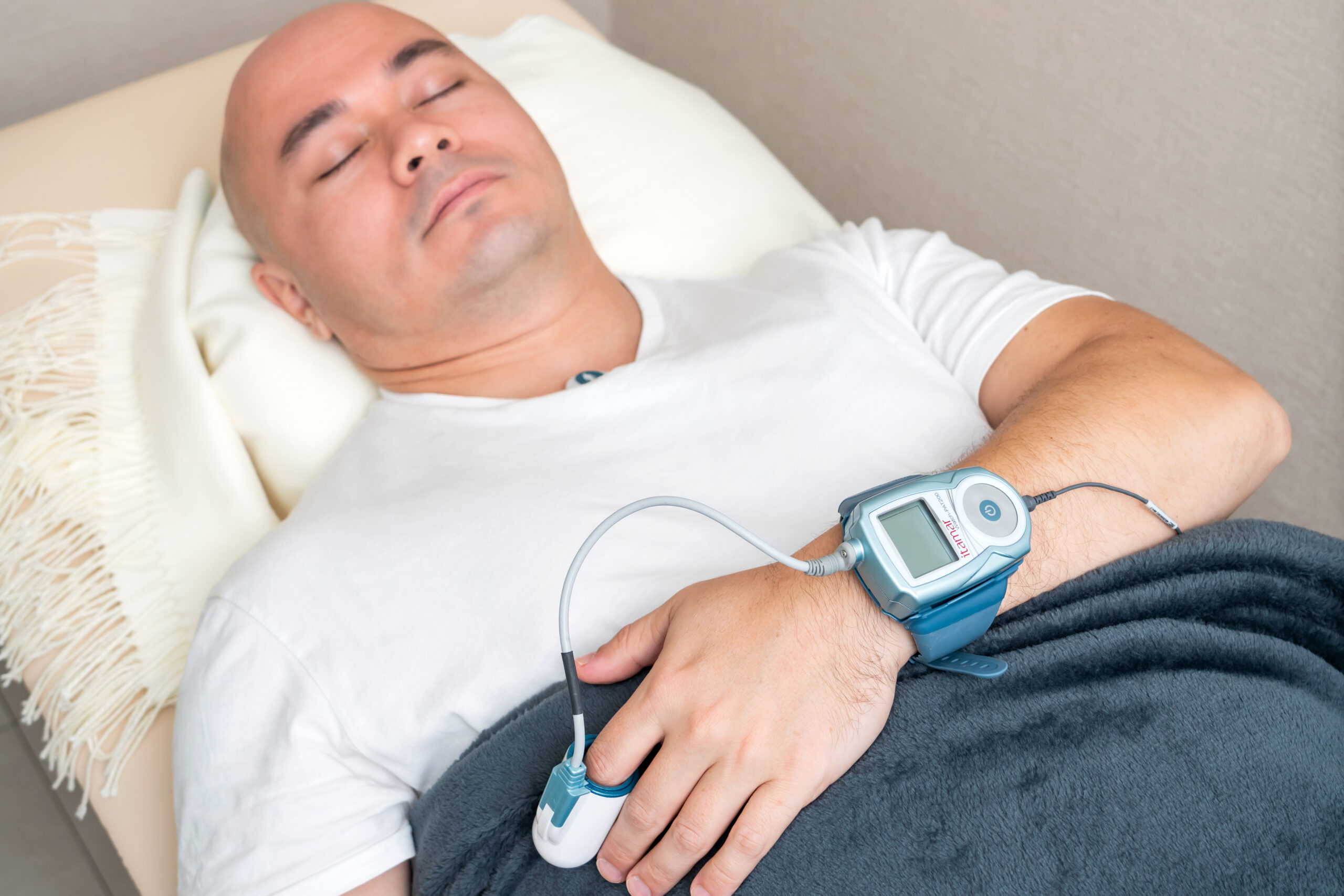
The home sleep test we use most frequently is the WatchPAT test. The test involves wearing a small computer on your wrist. You will also have a probe attached to your finger and another attached to your chest.

Our nurse will explain how to set up the device. You need to bring the machine home in a small case and set it up according to the steps described. Do remember to switch the device on before you go to sleep. Then, bring the machine back to the clinic the next day so we can download the data and go through the results with you.
Follow these steps to set up the machine just before you go to bed:
- Attach the chest sensor and secure it with surgical tape.
- Strap the watch to your non-dominate hand.
- Slip on the finger probe.
The following five minute video will walk you through the process:
What alternatives do I have?
A sleep test is necessary to make the diagnosis of OSA. However there are alternatives to a home sleep apnea test like the WatchPAT.
The main alternative to a home sleep test is a polysomnogram, which is the gold-standard test for diagnosing OSA. However, as its name suggests, polysomnography utilises multiple recording channels, which means that you will have a lot of wires attached to you. This can make it difficult to sleep comfortably.

Media credit: 邱鈺鋒, CC BY-SA 4.0 https://creativecommons.org/licenses/by-sa/4.0, via Wikimedia Commons.
In addition, a sleep technician must be present throughout the night for a Level 1 polysomnogram. Hence, we usually perform this test in the hospital or a sleep laboratory.
You can do a polysomnogram at home without a sleep technician in attendance, in which case it is a Level 2 sleep test. Nonetheless the test remains rather cumbersome and obtrusive.
Conversely, a home sleep test like the WatchPAT has a small computer attached to your wrist, with just two wires attached. Furthermore you can do the test in the comfort of your own bed!
Is a home sleep test accurate?
In short, a home sleep test like the WatchPAT is technically adequate and reasonably accurate. What does this mean?
The WatchPAT uses innovative technology to measure peripheral arterial tone (hence PAT). It combines this with actigraphy (detects movement) and oximetry (detects blood oxygen levels) to make the diagnosis of OSA. The American Academy of Sleep Medicine considers this test technically adequate to diagnose OSA. [1]
Results from home sleep apnea testing with the WatchPAT correlate well with the gold standard of polysomnography. A meta-analysis of 14 studies and 909 patients showed high correlation (89%) between WatchPAT and polysomnogram when diagnosing OSA, and an even higher correlation (94%) when comparing the oxygen desaturation index, a measure of how frequently blood oxygen levels drop due to OSA. [2]
Another more recent review of 18 studies and 1049 patients reported sensitivities ranging from 87 to 96%. This means that if you have OSA, the likelihood that the WatchPAT will diagnose it is 87 to 96%. [3]
What you will notice from these numbers is although that the WatchPAT is pretty good at picking up OSA, it is not perfect. This is particularly so when sleep apnea is mild, when it is possible to diagnose mild OSA even if there is none, or diagnose no OSA when in fact there is mild OSA. [4] For this reason, we sometimes need to progress on to a full polysomnogram if the diagnosis remains in doubt but suspicion of OSA is high.
Is the test suitable for everyone with suspected OSA?
Home sleep apnea testing may not be suitable in patients with the following:
1. Severe heart and lung disease with impaired breathing and blood oxygen levels.
2. History of stroke, which could cause central sleep apnea where breathing stops due to abnormal brain function.
3. Neuromuscular disorders with weakened breathing muscles.
4. Long-term use of opioid medication (addictive pain killers), which could also impair natural breathing reflexes.
5. Severe insomnia, as this may interfere with the accuracy of the test.
6. When testing for sleep related movement disorders and parasomnias (abnormal actions during sleep), which may be due to causes other than OSA.
7. When excessive daytime sleepiness may be due to a brain disorder rather than OSA. Also known as central hypersomnolence.
8. When environmental or personal factors preclude adequate acquisition and interpretation of data from a home sleep test.
Where can I find out more about sleep apnea diagnosis and treatment?
Read more about services for snoring and sleep apnea at Advanced ENT Centre.
Read more about conditions related to snoring and sleep apnea.
Contact us at Advanced ENT Centre to arrange an appointment.
References
1. Kapur VK, Auckley DH, Chowdhuri S, Kuhlmann DC, Mehra R, Ramar K, Harrod CG. Clinical Practice Guideline for Diagnostic Testing for Adult Obstructive Sleep Apnea: An American Academy of Sleep Medicine Clinical Practice Guideline. J Clin Sleep Med. 2017 Mar 15;13(3):479-504. doi: 10.5664/jcsm.6506. PMID: 28162150; PMCID: PMC5337595. [go back]
2. Yalamanchali S, Farajian V, Hamilton C, Pott TR, Samuelson CG, Friedman M. Diagnosis of Obstructive Sleep Apnea by Peripheral Arterial Tonometry: Meta-analysis. JAMA Otolaryngol Head Neck Surg. 2013;139(12):1343-1350. doi:10.1001/jamaoto.2013.5338. [go back]
3. Moffa A, Giorgi L, Carnuccio L, Mangino C, Lugo R, Baptista P, Casale M. New diagnostic tools to screen and assess a still too underestimated disease: the role of the wrist-worn peripheral arterial tonometry device-a systematic review. Sleep Breath. 2023 Jun;27(3):817-828. doi: 10.1007/s11325-022-02700-4. Epub 2022 Aug 29. PMID: 36036338. [go back]
4. Röcken J, Schumann DM, Herrmann MJ, Veitz S, Franchetti L, Grize L, Strobel W, Jahn K, Tamm M, Stolz D. Peripheral arterial tonometry versus polysomnography in suspected obstructive sleep apnoea. Eur J Med Res. 2023 Jul 22;28(1):251. doi: 10.1186/s40001-023-01164-w. PMID: 37481575; PMCID: PMC10362713. [go back]