
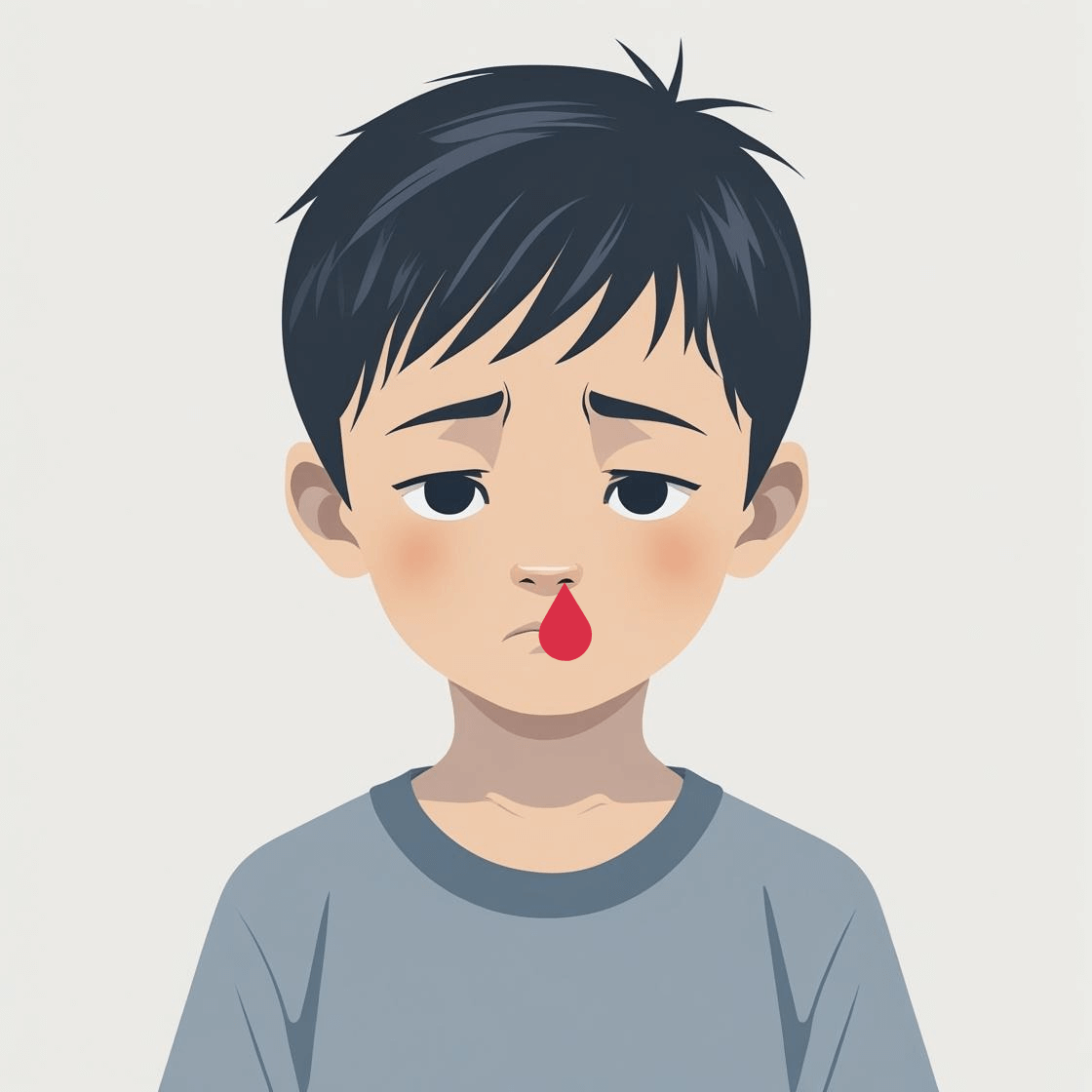
What are nosebleeds?
Nosebleeds, also known as epistaxis in medical language, refer to bleeding from inside the nose, usually due to trauma to the delicate blood vessels in the nose.
Bleeding typically arises at the front of the nose, from a place known as Little’s area. Little’s area is the meeting point of lots of little blood vessels on the nasal septum. The nasal septum is a thin wall of cartilage and bone separating the nose into right and left sides. The septum has a delicate lining containing numerous small blood vessels that warm, humidify, and filter the air as we breathe. These same blood vessels are delicate and easily injured.
Nosebleeds that arise from the front of the nose are referred to as anterior nosebleeds. Less commonly, bleeding can occur from deeper blood vessels at the back of the nose and is called posterior epistaxis.
During a nosebleed, blood flows out from one or both sides of the nose but can also flow backwards into the mouth.
Why do children get nosebleeds?
Children usually get nosebleeds when the small blood vessels at the front of the nose get traumatised. This typically happens as a result of picking the nose, rubbing it too much, or blowing the nose excessively.
These behaviours are often triggered by underlying untreated allergy, respiratory infections, and sometimes habit.
Cold dry climates, nasal sprays, facial injuries, or inserting objects into the nose can also lead to nosebleeds.
Can nosebleeds be life threatening for my child?
Nosebleeds can be quite dramatic, but fortunately, they are usually not a cause for serious concern. Furthermore, nosebleeds are common, with as many as one in two children experiencing a nosebleed at some time.
Most nosebleeds are anterior and relatively easy to manage. However, because posterior nosebleeds may involve larger blood vessels and result in blood flowing down the throat rather than out the nose, they can be harder to control.
Children with certain medical conditions such as blood-clotting disorders may also experience more frequent or severe nosebleeds.
How can I stop a nosebleed in my child?
- Stay calm. Remember, nosebleeds can be dramatic but are seldom life threatening.
- Get your child to sit upright and lean slightly forward. This prevents blood draining down the throat and causing nausea.
- Gently but firmly pinch the soft part of the nose (just above the nostrils) for 5 to 10 minutes without releasing. This will stop the bleeding in most cases.
- Encourage your child to breathe through their mouth while pinching their nose.
- Apply an ice pack over the bridge of the nose. This helps to constrict the blood vessels and reduce bleeding.
After bleeding stops, it is normal to see some blood clots come out from the nose or mouth. This is a sign of the body’s healing process.
What can I do if my child keeps having nosebleeds?
- Keep children’s nails trimmed and avoid nose picking.
- Refrain from rubbing the nose and forceful nose-blowing.
- Keep nasal passages moist with saline sprays or gels.
- Use a humidifier, especially in dry environments.
- Treat underlying causes such as allergies. You may need help from your doctor for this.
- Have a specialist examine your child’s nose. This may involve looking in your child’s nose with a small camera to identify the source of bleeding.
When should I see a doctor for my child’s nosebleeds?
See the doctor if your child has recurring nosebleeds that are difficult to stop or disrupt daily life.
You should seek emergency care if bleeding persists beyond 30 minutes, exceeds a cup in volume, or causes breathing difficulties or vomiting from swallowed blood.
What are some medical treatments for nosebleeds?
Recurrent nosebleeds can sometimes be treated with ointment to reduce crusting and irritation in the nose.
We may also need to treat nose allergies if these are contributing to the bleeding.
For persistent, troublesome bleeding, we may recommend cauterization. This is a simple procedure that numbs the nose and seals the blood vessel. It is usually performed in the clinic but can also be carried out under a short general anesthestic.
Occasionally, for very severe bleeding, we may need to insert a sponge pack into the nose to apply pressure to the vessel while waiting for it to heal.
Fortunately, most nosebleeds resolve with preventive measures, but persistent cases may require professional intervention.
How do I find out more?
Read more about our Childrens’ ENT services. Or contact Advanced ENT Centre for an appointment.
Some scientific articles on nasal cautery
Ozmen S, Ozmen OA. Is local ointment or cauterization more effective in childhood recurrent epistaxis. Int J Pediatr Otorhinolaryngol. 2012 Jun;76(6):783-6. doi: 10.1016/j.ijporl.2012.02.040. Epub 2012 Mar 10. PMID: 22409966. [Antiseptic ointment can be as effective as nasal cautery for nosebleeds in children]
Drake I, Fountain H, Kubba H. Is It Safe to Cauterise Both Sides of the Nasal Septum at the Same Time in Children With Nosebleeds? Clin Otolaryngol. 2025 Mar;50(2):295-299. doi: 10.1111/coa.14258. Epub 2024 Nov 11. PMID: 39529239. [Cauterizing both sides of the nasal septum raises concerns about causing a perforation in the septum; but this and other studies suggest the concern may be unfounded]
Johnson N, Faria J, Behar P. A Comparison of Bi-polar Electrocautery and Chemical Cautery for Control of Pediatric Recurrent Anterior Epistaxis. Otolaryngol Head Neck Surg. 2015 Nov;153(5):851-6. doi: 10.1177/0194599815589583. Epub 2015 Jun 30. PMID: 26129737. [Electrocautery may be a superior treatment in children who will not tolerate in-office chemical cautery and in those with risk of severe bleeding]